
Elmwood Park Previous Residents by Era
One address needs evidence from more than one era. Begin with the current assessment parcel, then use the recorded deed chain to work backward. Add an older directory, census schedule, map, permit record, or archive item only after the legal description and block or lot show that the records concern the same place. Ownership, mailing address, and historical presence are different forms of evidence. The table separates the available routes and their limits.
| Source | Years | Where | What It Shows |
|---|---|---|---|
| Bergen land-record index | January 1, 1970 to present | Bergen County Clerk | Recorded parties, instruments, dates, and document references |
| Deed books and microfilm | Before 1970 | County Clerk Records Division | Earlier title research through an office route |
| East Paterson Sanborn | January 1925 | Library of Congress | Street, building, and use context across eight sheets |
| Regional directories | Selected dates, not a verified borough run | GSBC and BCHS | Dated address and household leads requiring page verification |
| Federal census | Schedules released after 72 years | Archive and library databases | Household context for one census date |
For a recent transfer, the land index is the best start. For a pre-1970 question, move to the clerk's older-record route rather than assuming the online trail is complete. For a 1925 question, the map establishes geography but not ownership or occupancy.
Elmwood Park's 1970 Deed Boundary
The Bergen County public land-record search begins online on January 1, 1970. It offers basic and advanced search paths, but the research capture did not return a populated Elmwood Park result. Preserve only visible information from a live result, including grantor, grantee, party role, instrument type, recording date, book or document number, legal description, and image availability. County staff can explain access and provide public viewing or copies, but cannot perform the historical search for a requester.
The Bergen County Clerk's Elmwood Park historic documents collection adds a different local route.
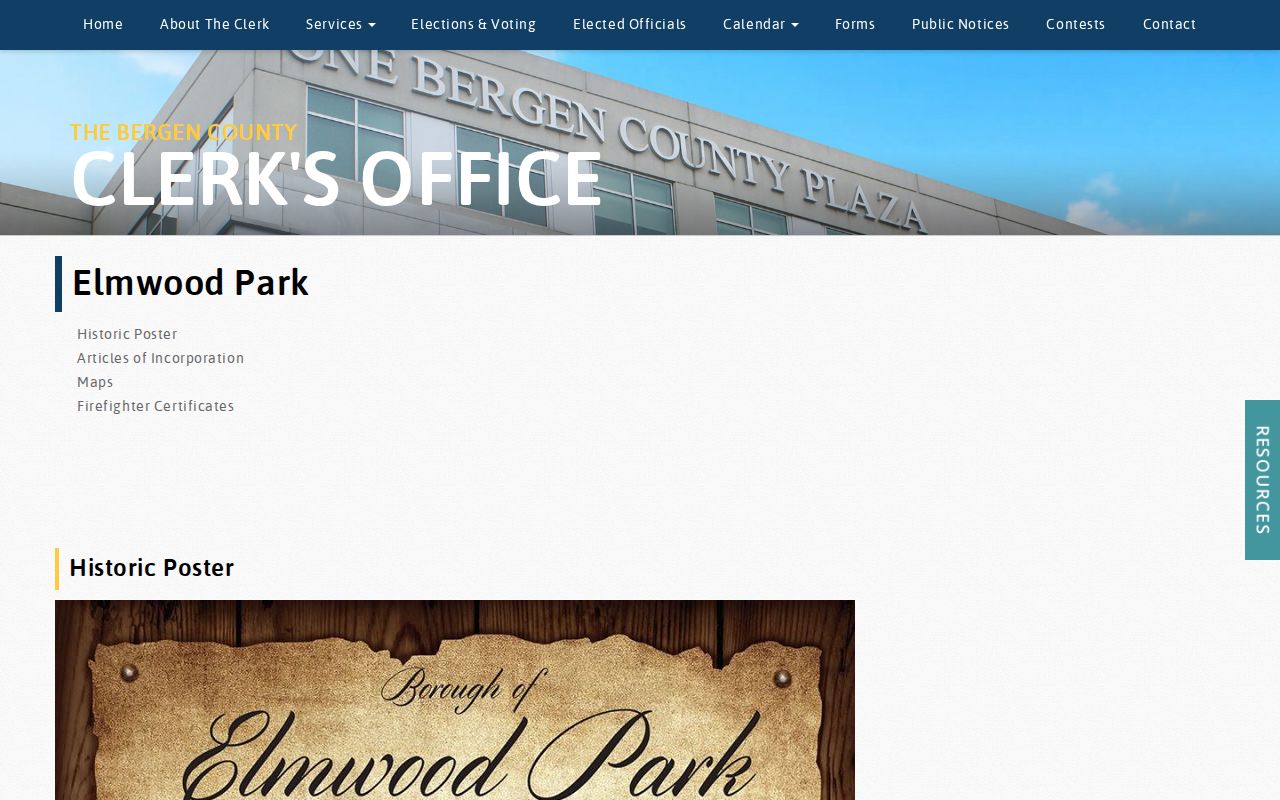
Its borough-specific material includes incorporation records, maps, and firefighter certificates. These documents can help establish historical institutions or place names, but they should be cited as historic material rather than treated as a substitute for a deed.
Trace Elmwood Park Previous Residents Through Deeds
A chain of title is a sequence of recorded transfers for the same parcel. Start with the assessment search to obtain the location and block, lot, and qualifier. Then find the current or most recent transfer, record its parties and legal description, and look for the seller's earlier acquisition. Use alternate spellings and both Elmwood Park and East Paterson where the date supports them. The legal description is more stable than a street address when an address changes.
- Search the county assessment portal by location and save the block, lot, qualifier, and situs information.
- Locate the latest related transfer in the Bergen land-record index and record the instrument details.
- Search the prior grantor as a grantee to identify that party's acquisition record.
- Repeat the transaction sequence while checking the legal description against the parcel.
- When the web index reaches 1970, continue through County Clerk deed books or microfilm.
- Grantor and grantee
- The grantor transfers an interest; the grantee receives it in the recorded instrument.
- Chain of title
- The dated sequence of transfers associated with one parcel.
- Legal description
- The recorded parcel description that helps distinguish one location from a similar street address.
Elmwood Park Previous Residents in East Paterson
Elmwood Park became the official name on January 1, 1973 after a 1972 vote. Earlier sources may use East Paterson, and earlier context can also point to Dundee Lake, Rosemont, or Saddle River Township. The borough's story is a practical search tool. Residents voted to form East Paterson Borough in 1916, and Rosemont followed through annexation in 1917. Repeating a historical search under these place names can surface a map, article, deed, or archive reference that a modern place label misses.
The 1925 Sanborn set is labeled East Paterson and has eight sheets. It can relate a street to a block, building footprint, or historical use. Compare its street label with current parcel geography before deciding that an address refers to the same place. No official borough-wide renumbering schedule was found, so do not presume that a street number changed without source evidence.
Elmwood Park Directory and Census Pairing
Deeds document recorded property roles, not who lived at an address. A dated directory or telephone listing may add a household lead, and a released census schedule may add a household for one census year. Pair each item by date, address spelling, and source type. The Genealogical Society of Bergen County describes a regional microfilmed directory run from 1897 to 1973 with a 1914 to 1926 gap, but that is not proof of an Elmwood Park entry in every year. Bergen County Historical Society lists selected regional telephone directories that also need page verification.
Ask the repository for the exact title, year, page, and whether the entry is residential, business, or institutional. The Elmwood Park city directory resources identify the collections themselves. Use an obituary, cemetery record, or probate file as corroboration at the end of a household trail, never as proof of the next owner.
Note: Record the directory year and census date beside every address so a past household is not presented as continuous occupancy.
Elmwood Park Archive and Permit Trails
The Richard A. Mola Library Local History Archives offer a borough-specific research stop for East Paterson and Elmwood Park yearbooks, Historical Society material, photographs, scrapbooks, and Mola collections. The library says the archives were established by a March 2021 board resolution and received curator support through a 2022 Bergen County History Grant. Materials are for library research and are not all catalogued. Ask the curator for a collection name, date range, box or folder, and reproduction rule.
Permits and code records can provide dated construction or alteration evidence, but no public online Elmwood Park permit or code index was verified. Send a narrow request to the municipal building or code custodian with the address and date range. Treat a no-result as an access or indexing outcome, not proof that work never occurred.
Elmwood Park Previous Residents Evidence
Label every finding by what it establishes. An assessment record can identify an assessed owner. A deed names parties to a recorded transfer. A map dates the built environment. A directory and census record can provide a historical address or household lead. Those distinctions matter when a name recurs or a place name changes. The strongest address history places two independent, dated records beside each other and explains any gap.
For a missing record, log the search spelling, East Paterson or Elmwood Park label, identifier, date range, and no-result state. This is especially important because online deed coverage stops in 1970, exact local directory pages were not verified, and the archive collections are not fully catalogued.
Elmwood Park Previous Residents Limits
Past-resident research is best used for family history, house history, estate questions, and local historical work. It must not turn old address material into a way to track a living person. New Jersey's Address Confidentiality Program and Daniel's Law can require address suppression. A historical assessment or directory entry also does not establish a current address. Use the minimum location detail needed for the record question and honor redactions.
Lawful use. Use Elmwood Park previous-resident sources for lawful historical research and official requests. Do not use an old record to stalk, harass, threaten, or intimidate any person.
Requests under the New Jersey Open Public Records Act, N.J.S.A. 47:1A-1 et seq., should name an existing record and time period. Ask the custodian for a redacted non-exempt portion where one is available.